When Callie lives out loud, that’s the sound of profound made possible by FINTEPLA

Callie, living with Dravet syndrome
Taking FINTEPLA since 2017


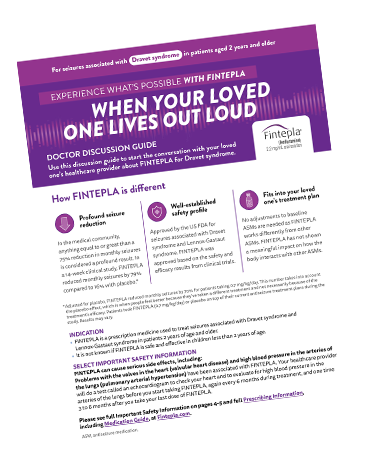
In the medical community, anything equal to or greater than 75% reduction in monthly seizures is considered a profound result.

In a clinical trial for Dravet syndrome, FINTEPLA reached this achievement.
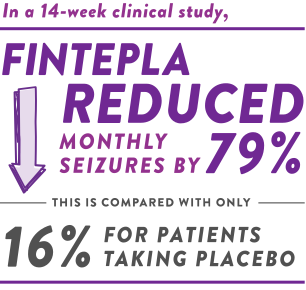
In a 14-week clinical study, FINTEPLA reduced monthly seizures by 79%. This is compared with only 16% for patients taking a placebo

Adjusted for placebo, FINTEPLA reduced monthly seizures by 70% for patients taking 0.7 mg/kg/day. This number takes into account the placebo effect, which is when people feel better because they’ve taken a different treatment and not necessarily because of the treatment’s efficacy.

Patients took FINTEPLA (0.7 mg/kg/day) or placebo on top of their current antiseizure treatment plans during the study. Results may vary.
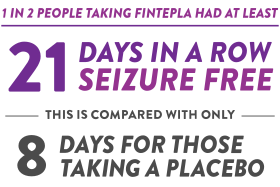
 
1 in 2 people taking FINTEPLA had at least 21 days in a row seizure free, this is compared with only 8 days for those taking placebo

In a clinical study, 50% of patients taking FINTEPLA (0.7 mg/kg/day) had a seizure-free streak lasting at least 21 days. This is compared with 8 days for patients taking placebo.


About the Dravet syndrome clinical study

Safety and effectiveness of FINTEPLA were evaluated in 2 clinical studies of patients with Dravet syndrome aged 2 years and older. Study 1 had 117 patients and Study 2 had 85 patients.

Study 1 compared improvement in monthly seizure frequency of 2 different doses of FINTEPLA versus placebo over a 14-week treatment period.

Before joining FINTEPLA Study 1, patients had:

  • Uncontrolled seizures: 6 or more convulsive seizures over the course of 6 weeks
  • A current treatment plan for seizures: 1 to 4 antiseizure medicines or treatments, including use of a vagal nerve stimulator or a ketogenic diet

In the study, patients were randomly placed into 1 of 3 groups:

  • Patients taking 0.2 mg/kg/day of FINTEPLA (n=38)
  • Patients taking 0.7 mg/kg/day of FINTEPLA (n=40)
  • Patients taking placebo (n=39)

All patients added either FINTEPLA or placebo to their existing treatment plans.

The sound of Profound seizure reduction

Having seizure-free 
moments allows her to live 
an 11-year-old’s life.

— Darlene, Callie’s mom

Long-term results

From the original clinical studies,
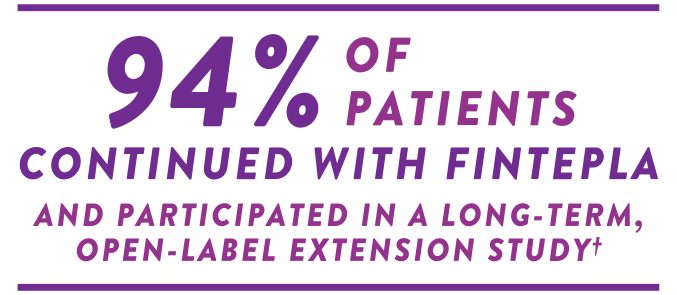
94% of patients continued with FINTEPLA and participated in a long-term, open-label extension study

Throughout this 36-month, long-term, open-label extension study, most patients maintained the seizure reduction they experienced in the clinical studies.

An open-label study means patients knew they were being treated with FINTEPLA and not a placebo. Since this was an open-label, flexible-dose study, no conclusions of efficacy or safety should be made based on these results. Results may vary.

In this open-label extension study,
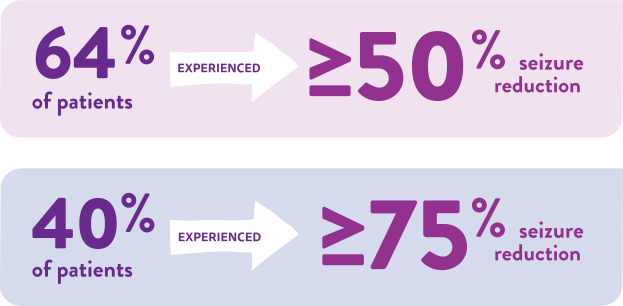
64% of patients experienced >50% seizure reduction. 40% of patients experienced >75% seizure reduction.

Patients added FINTEPLA (up to 0.7 mg/kg/day) to their current antiseizure treatment plans. Since this was an open-label, flexible-dose study, no conclusions of efficacy or safety should be made based on these results. Results may vary. An open-label study means patients knew they were being treated with FINTEPLA and not a placebo.

How FINTEPLA fits into your loved one’s treatment plan

Adding FINTEPLA to your loved one’s treatment plan for Dravet syndrome can lead to profound seizure reduction results.

Image
Watch a video about how FINTEPLA fits into your loved one’s treatment plan
Play button
FINTEPLA can fit your loved one's current treatment plan
 

Considering FINTEPLA for Dravet syndrome?

Download a Discussion Guide designed to help you navigate these important conversations with your healthcare provider.


Ask your questions in real time

ONWARD® offers comprehensive support for patients prescribed FINTEPLA.

Stay Informed

Interested in receiving helpful information about FINTEPLA and Dravet syndrome?

Register below to personally receive support resources, inspiring patient stories, educational content, and more.

The fields marked with an asterisk (*) are mandatory.
Which of the following best describes you?
Is your loved one currently taking FINTEPLA?
So we can best support you, how long has your loved one been taking FINTEPLA?

Important Safety Information

FINTEPLA can cause serious side effects, including:

  1. 1.Problems with the valves in the heart (valvular heart disease) and high blood pressure in the arteries of the lungs (pulmonary arterial hypertension) have been associated with FINTEPLA. Your healthcare provider will do a test called an echocardiogram to check your heart and to evaluate for high blood pressure in the arteries of the lungs before you start taking FINTEPLA, again every 6 months during treatment, and one time 3 to 6 months after you take your last dose of FINTEPLA.

    Call your healthcare provider right away if you develop any of these signs and symptoms of heart or lung problems during treatment with FINTEPLA:

    • shortness of breath
    • tiredness or weakness, especially with increased activity
    • lightheadedness or fainting
    • swollen ankles or feet
    • chest pain
    • sensations of a rapid, fluttering heartbeat (palpitations)
    • irregular pulse
    • bluish color of your lips and skin (cyanosis)

    Because of the risk of heart valve problems (valvular heart disease) and high blood pressure in the arteries of the lungs (pulmonary arterial hypertension), FINTEPLA is only available through a restricted program called the FINTEPLA Risk Evaluation and Mitigation Strategy (REMS). Before you or your child receives FINTEPLA, your healthcare provider or pharmacist will make sure you understand how to take FINTEPLA safely. If you have any questions about FINTEPLA, ask your healthcare provider, visit www.FinteplaREMS.com, or call 1-877-964-3649.

  2. 2. Decreased appetite and decreased weight. Decreased appetite and decreased weight are serious and common side effects of FINTEPLA.

    • Your weight should be checked regularly during your treatment with FINTEPLA.
    • Your healthcare provider may need to make changes to your FINTEPLA dose if your weight decreases. In some cases, FINTEPLA may need to be stopped.
  3. 3. Sleepiness, sedation, and lack of energy (lethargy). These are serious and common side effects of FINTEPLA. Taking FINTEPLA with central nervous system (CNS) depressants, including alcohol, may increase sleepiness. Do not drive, operate heavy machinery, or do other dangerous activities until you know how FINTEPLA affects you.

  4. 4. Like all other antiepileptic drugs, FINTEPLA may cause suicidal thoughts or actions in a very small number of people (about 1 in 500). Call your healthcare provider right away if you have any of these symptoms, especially if they are new, worse, or worry you: thoughts about suicide or dying; trouble sleeping (insomnia); attempts to commit suicide; new or worse irritability; new or worse depression; acting aggressive, being angry or violent; new or worse anxiety; acting on dangerous impulses; feeling agitated or restless; an extreme increase in activity and talking (mania); panic attacks; other unusual changes in behavior or mood.

    How can I watch for early symptoms of suicidal thoughts and actions?

    Pay attention to any changes, especially sudden changes, in mood, behaviors, thoughts, or feelings. Keep all follow-up visits with your healthcare provider as scheduled.

    Suicidal thoughts or actions can be caused by things other than medicines. If you have suicidal thoughts or actions, your healthcare provider may check for other causes.

  5. 5. Do not stop taking FINTEPLA without first talking to your healthcare provider. Stopping a seizure medicine such as FINTEPLA can suddenly cause you to have seizures more often or seizures that do not stop (status epilepticus).

    Do not take FINTEPLA if you:

    • are allergic to fenfluramine or any of the ingredients in FINTEPLA. See the Medication Guide for a complete list of ingredients in FINTEPLA.
    • are taking or have stopped taking medicines called monoamine oxidase inhibitors (MAOIs) in the last 14 days. This may cause a serious or life-threatening problem called serotonin syndrome. If you are not sure whether or not you are taking one of these medicines, contact your healthcare provider.

    Before taking FINTEPLA, tell your healthcare provider about all your medical conditions, including heart problems; weight loss; depression, mood problems, or suicidal thoughts or behavior; kidney problems; liver problems; are pregnant or plan to become pregnant; are breastfeeding or plan to breastfeed.

    Tell your healthcare provider about all the medicines you take, including prescription and over-the-counter medicines, vitamins, and herbal supplements.

    What are the possible side effects of FINTEPLA?

    FINTEPLA may cause serious side effects, including:

    • See “FINTEPLA can cause serious side effects” above
    • Serotonin syndrome. Serotonin syndrome is a life-threatening problem that can happen in people taking FINTEPLA, especially if FINTEPLA is taken with certain other medicines, including anti-depressant medicines called SSRIs, SNRIs, TCAs, and MAOIs; tryptophan; lithium; antipsychotics; St. John’s Wort; dextromethorphan; tramadol.

      Call your healthcare provider right away if you have any of the following symptoms of serotonin syndrome: mental status changes such as seeing things that are not there (hallucinations), agitation, or coma; changes in blood pressure; tight muscles; fast heartbeat; nausea, vomiting, or diarrhea; high body temperature; trouble walking.

    • High blood pressure (hypertension). Hypertension is a serious and common side effect. FINTEPLA can cause your blood pressure to increase even if you have never had high blood pressure before.
    • Increased pressure in your eyes (glaucoma). Symptoms of glaucoma may include red eyes, seeing halos or bright colors around lights, nausea or vomiting, decreased vision, eye pain or discomfort, blurred vision.

      If you have any of these symptoms, call your healthcare provider right away.

The most common side effects of FINTEPLA when used to treat patients with Dravet syndrome (DS) include decreased appetite; diarrhea; low energy; respiratory infection; decreased weight; fever; constipation; abnormal echocardiogram; sleepiness; problems with movement, balance, and walking; increased drooling; increased blood pressure; vomiting; falls; seizures that do not stop; weakness.

The most common side effects of FINTEPLA when used to treat patients with Lennox-Gastaut syndrome (LGS) include diarrhea; tiredness; vomiting; sleepiness; decreased appetite.

These are not all the possible side effects of FINTEPLA. For more information, ask your healthcare provider or pharmacist. Tell your healthcare provider if you have any side effect that bothers you or that does not go away.

Indication

  • FINTEPLA is a prescription medicine used to treat seizures associated with Dravet syndrome and Lennox-Gastaut syndrome in patients 2 years of age and older.
  • It is not known if FINTEPLA is safe and effective in children less than 2 years of age.

Call your doctor for medical advice about side effects. You may report side effects to the FDA at 1-800-FDA-1088. Keep FINTEPLA and all medicines out of the reach of children.

Please see full Prescribing Information, including Medication Guide, for additional Important Safety Information on FINTEPLA.